X7000LT – Industrial CT, Scaled to the Parts Defense Programs Build
There’s a specific moment many NDT engineers in aerospace and defense know. You’re looking at a rocket motor casing, a composite blade, a tall aerostructure, and you already know the answer before they ask. The part won’t fit.
From there, the options are all bad. You section the part and lose it. You stitch multiple scans and spend days post-processing hoping the data matches the part, and it often doesn’t. You ship offsite and surrender control of your schedule. None of these are engineering solutions. They are workarounds to a physical constraint the market has tolerated for too long.
A Proven Platform, Scaled Up
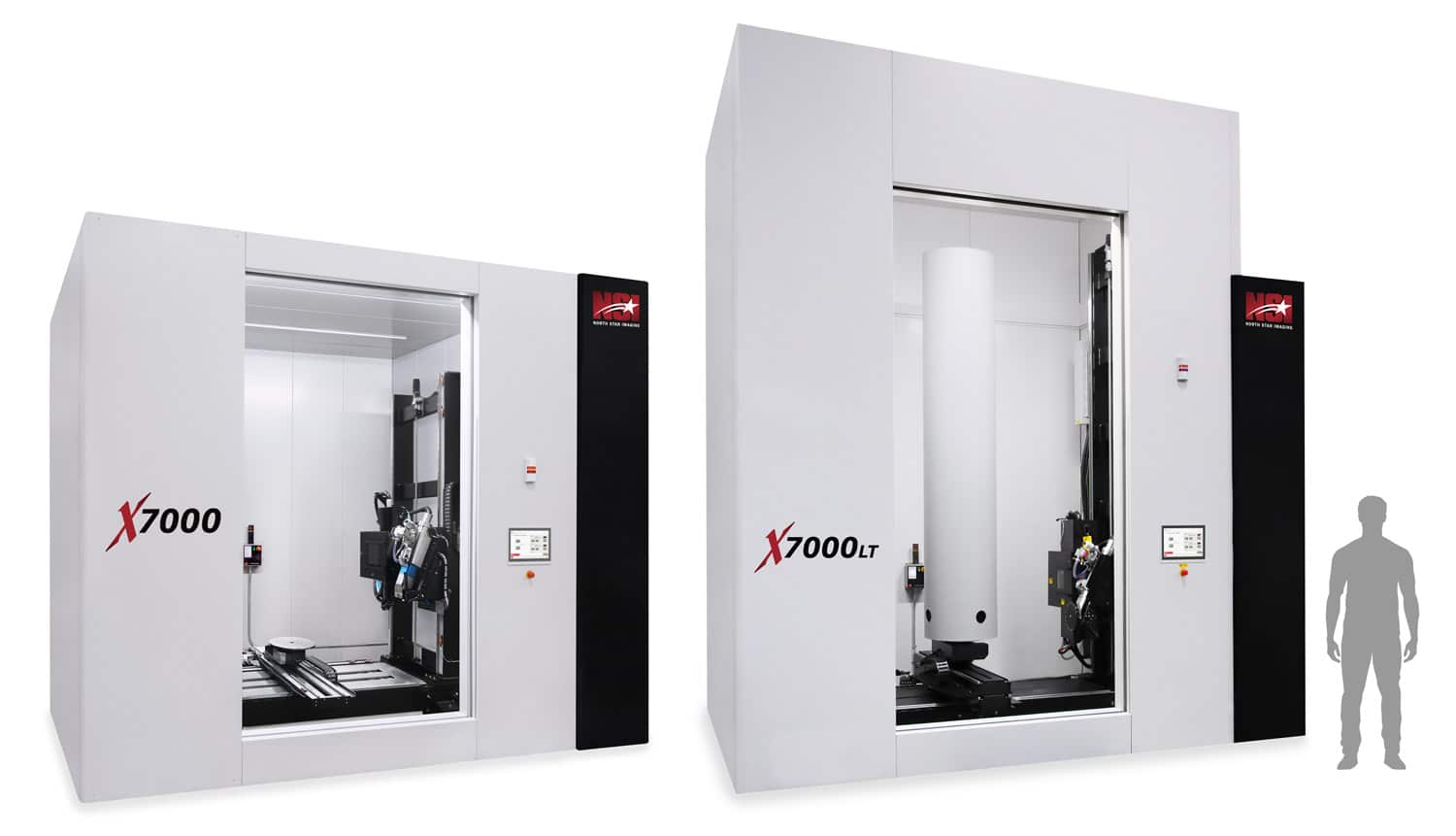
The X7000LT isn’t a concept. NSI has delivered extended-height systems into the field for aerospace and defense customers doing regulated production work on parts that standard cabinets couldn’t accommodate. The extended architecture has been validated in challenging environments on aerospace-grade parts.
This extends the X7000: NSI’s largest standard cabinet system without changing what operators already know. Same motion system, detector and source options, software, and 450 kV capability. What changes is the envelope, scaled to the parts defense programs build: solid rocket motors, elongated missile bodies, rotor blades, tall composite aerostructures where joint-free construction demands full-part volumetric data.
When you’re evaluating a x-ray system, “built on a platform your operators already run and NSI already services” is a meaningful differentiator versus a custom-engineered solution.
What the System Is Designed to Handle
The X7000LT targets tall, regulated, flight-critical parts where CT is increasingly the specified or required inspection method:
Solid rocket motors and missile bodies requiring full-length internal inspection for bond integrity, voids, and geometry.
Rotor blades and similar composite structures where lamination defects and internal geometry must be characterized over the full span.
Tall composite aerostructures fuselage frames, wing spars, integrated panels where joint-free construction demands volumetric data.
R&D and qualification programs developing new materials and structures against inspection specifications that didn’t previously exist.
In each case, the alternative to capable in-house CT is sectioning, stitching, or outsourcing. All three introduce risk to the part, to the schedule, or to the integrity of the data itself.
The Practical Decision
When a part exceeds your scanning envelope, you don’t just lose the scan you hold up the program. For inspection programs with large parts in regulated production, where records are mandatory and schedule pressure is constant, the case for in-house capability is clear. The X7000LT is built for that environment.
Talk to the NSI applications team to determine the right product for your parts and inspection requirements.
Talk to Our Experts